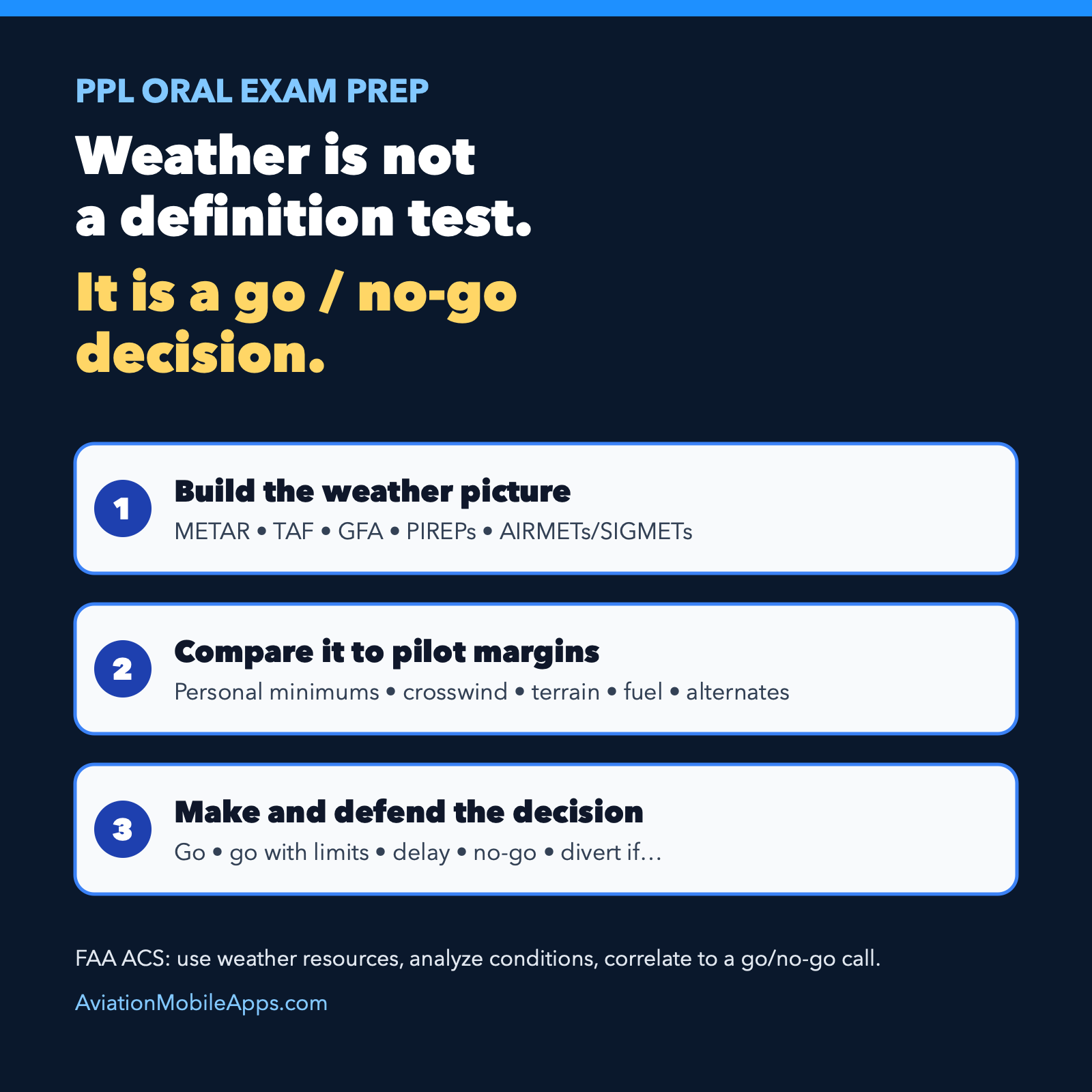
Stop memorizing weather. Start defending a decision.
If you are preparing for a Private Pilot oral, do not study weather as a pile of definitions. Study it as a go / no-go decision.
The FAA Private Pilot Airplane ACS lists Weather Information as a practical-test task. The applicant is expected to use available aviation weather resources, analyze conditions, and correlate that information into a go/no-go decision.
A strong oral answer sounds less like “a TAF is…” and more like: “Here is the weather picture, here are the risks, here are my personal limits, and here is my decision.”
A simple PPL oral weather flow
1. Build the weather picture
Use METARs, TAFs, GFA, winds aloft, PIREPs, AIRMETs/SIGMETs, and convective outlooks. Do not just read them—translate them into what the flight will feel like.
2. Compare it to pilot margins
Ceiling, visibility, crosswind, gust spread, terrain, fuel stops, alternates, daylight, fatigue, and recent experience all matter.
3. Name the risk plainly
Examples: lowering ceilings near destination, gusts near demonstrated crosswind, convective activity along the route, turbulence beyond passenger comfort, or no good divert option.
4. Make the call
Say one of four things: go, go with limits, delay, or no-go. A DPE can work with a conservative decision. They cannot work with vague confidence.
5. Give your trigger
Before takeoff, decide: “I will divert if ceilings drop below ___, visibility falls below ___, groundspeed/fuel reserve drops below ___, or turbulence exceeds ___.”
Bookmark drill
Before your next mock checkride, take one real cross-country weather briefing and write a three-line answer:
Weather picture:
Risk:
Decision + divert trigger: